
When gold was discovered in the late 1850’s, it didn’t take long for prospectors from the Eastern half of the United States to flood Colorado in search of their fortune. The population in the Denver area grew quickly, with more than 100,000 residents by 1880. While businesses flourished supporting the mining industry, a community was growing, wanting and establishing art and culture.
In 1893 a group of six women and four men created the Artist’s Club of Denver, “to cultivate and promote a general interest and promotion of the arts”. Founding members included Henrietta “Nettie” Bromwell and Anne Evans.
Bromwell, a prominent local artist who studied and earned an art degree from the University of Denver, was active in local politics. She worked with the Colorado State Legislature supporting women’s suffrage. As an artist, she held the position of Secretary in the Artist’s Club, where she handled the club’s clerical needs, and helped organize catalogs and shows.
Anne Evans was another prominent artist in Denver who was instrumental in the development of the Artist’s Club. Arriving in Denver in 1862, she came with her father, John Evans, who served as the Territorial Governor. Anne was an active civic leader who assisted in the development of the Denver Public Library, and Denver Civic Center.
As an artist, Evans supported arts education at the University of Denver. Outside of the Denver area, she assisted in the restoration of the Central City Opera House and the establishment of the Central City Opera Festival.
The Artist’s Club of Denver held art exhibits in City Hall, the Museum of Natural history and other temporary locations. With the completion of the Denver Public Library in 1910, the club found its first permanent home and exhibit space on the top floor. In 1917 the club was incorporated as the Denver Artist Association.
The organization continued to grow and in 1921 changed its name to the Denver Art Museum. Two years later the museum found a new home in the 22 room Chappell House on Logan Street. In 1928 the museum received an unexpected gift that would forever change the course of the business.
Hellen Dill, daughter of a wealthy businessman in Vermont, came to Denver in the early 1870s and worked most of her life as a school teacher. In an astute investment, Dill socked away a small fortune, well beyond her income as a teacher. Upon her death in 1928, she left the Denver Art Museum about $120,000, or $2 million in today’s dollars.
With this influx of funds, the museum established their new home in the City and County Building. The endowment from Dill also allowed the museum to purchase major works of art including one of Claude Monet’s water lily pond paintings.
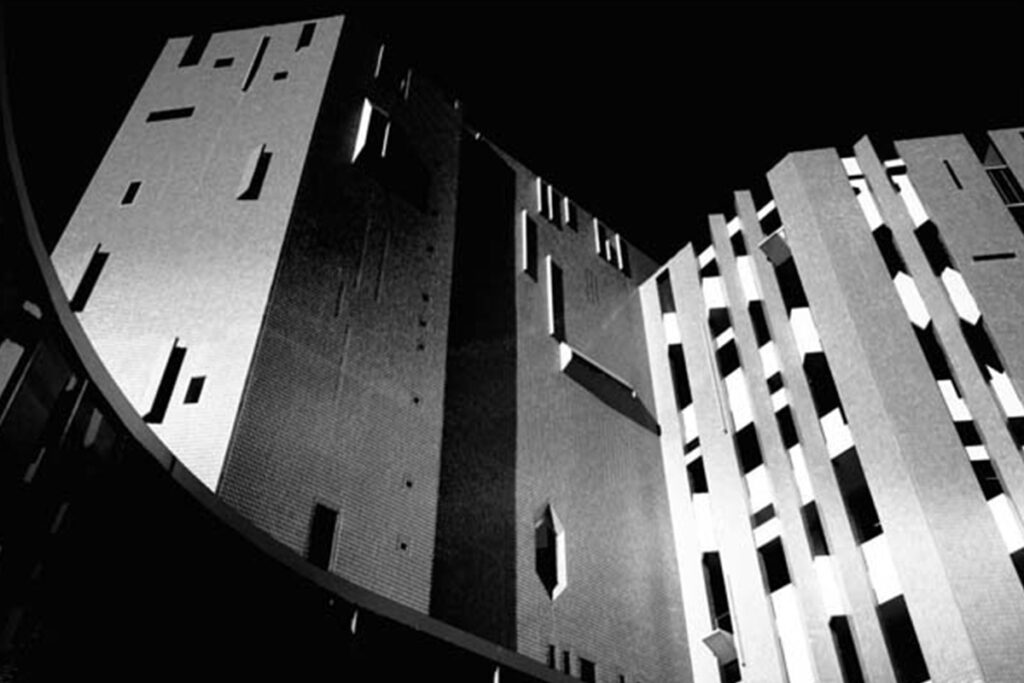
Moving into the City and County Building in 1932, the museum continued to grow, adding at least five additional locations to house the expanding art collections. In 1971 the seven-story, 210,000-square-foot castle, located at Bannock Street and West 14th Avenue, opened as the museum’s main location.
Designed by Gio Ponti, a well-known Milan artist and architect, the outer shell of the concrete structure is covered in more than a million reflective gray glass tiles, custom designed by the Corning Glass Company. Ponti’s vision in using glass tiles was to pick up the variety of the Colorado sky’s reflections. He designed buildings around the world, with The Denver Art Museum being the only one completed in the United States.
In 2006, at a cost of $110 million, the museum expanded with a 146,000-square-foot building resembling pointed shards. One of the massive prows reaches across West 13th Avenue, while another points to the original castle building.
From its humble beginnings as a ten member artist club 130 years ago, the Denver Art Museum has become the largest of its kind between Chicago and California. As part of the Scientific and Cultural Facilities District, the publicly supported museum continues to build and expand. With almost 400 staff members and an annual budget of $30 million, the museum welcomes 850,000 visitors a year.
Views: 64