

In the late 1800’s the Colorado gold rush brought thousands of people to the area, many of them prospectors in search of their fortunes buried in the mineral rich mountains. But it wasn’t just people who came to the area to work the mines. A variety of domesticated animals were brought to provide the additional muscle needed in mining and moving tons of gold-laden ore.
The burro was the primary choice of the gold miner. The Spanish term for “Donkey”, the burro was compact and more durable than a horse, and was smart enough to know when to duck its head in low passages. The burro’s job was to pull ore-filled carts through the gold mines. In the early years, some lived their entire lives underground, never seeing the light of day. Upon hearing this, President Theodore Roosevelt believed this treatment of the burros was inhumane and passed a law requiring the animals to get at least one hour of daylight per day.

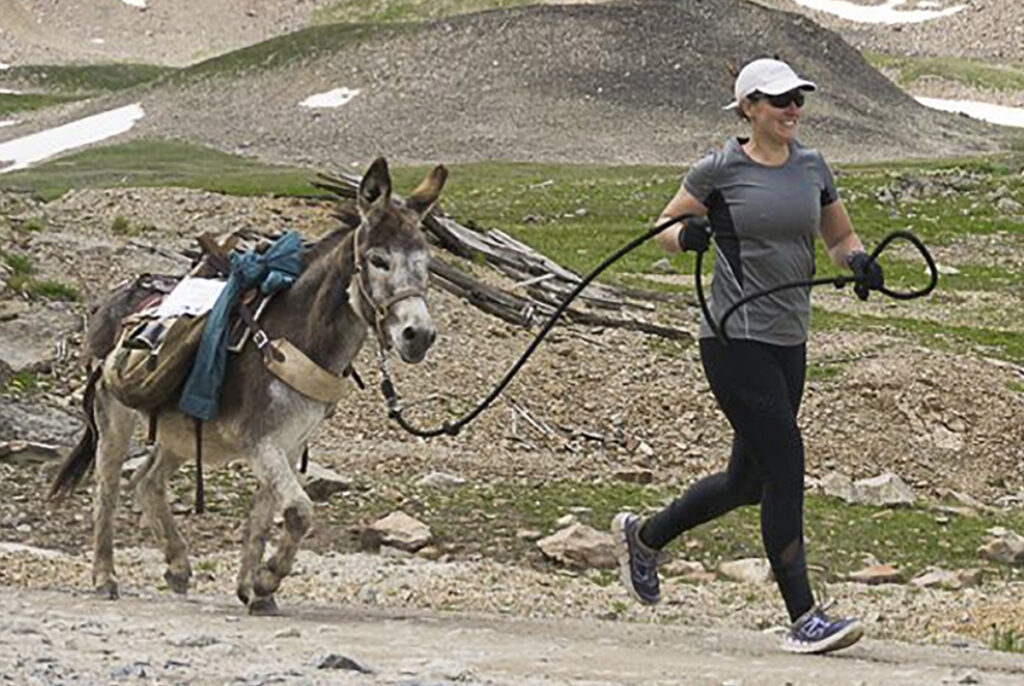
A Runner and her Burro in Fairplay 2018. Photo courtesy of Kim Welk and Western Pack Burro Association www.packburroracing.com.
Aside from pulling ore carts, the burro would carry tools, supplies and sometimes gold between the mine and nearby towns. A healthy burro can carry or pull up to twice its own body weight. Legend has it that two miners simultaneously discovered gold in the same area and raced with their burros in tow back to town to make their claim. This race to town is believed to be the beginning of Pack Burro Racing.
Indigenous to Colorado, Pack Burro Racing is a recognized sport with the first organized event taking place in 1949. As a tribute to Colorado’s mining heritage, races are held throughout the summer in eight mining towns. Leadville, Fairplay, Buena Vista, Georgetown, Idaho Springs, Creede, Victor, and Frederick each hold a race in conjunction with a celebratory festival. In 2012 the State Legislature recognized Pack Burro Racing as Colorado’s Summer Heritage Sport.
The rules are generally simple. One competitor must complete the designated course while leading a single burro with a rope. The burro must carry a saddle pack with a load of at least 33 pounds which includes a pick, shovel and gold pan. The contestant may not ride the burro, however the burrow may ride or be carried by the contestant. There are strict guidelines for the care of the burro and any sign of abuse carries an immediate disqualification of the contestant.
The race runs on average between 10 and 20 miles depending on the location. While it may seem to be an easy task jogging along a trail with a burro in tow, “Stubborn as a Mule” is a term that applies here. Weighing between 400 and 1,000 pounds, the burro will go – or not go – where it pleases.
Pack Burro racing is unique to Colorado and carries the region’s heritage from the gold rush 160 years ago. Races are scheduled through the summer. Visit the Western Pack Burro Association for more information and an upcoming race schedule.

Views: 6
